Selecting an LED driver by wattage alone is a common way to create an incompatible assembly. Two drivers marked with the same power can control their outputs differently, support different voltage windows and accept different dimming signals. Begin with the documented requirements of the LED module or strip, then choose the power device that meets those requirements under the intended conditions.
This guide is for product planning and procurement. It does not provide mains connection instructions. The fixture engineer and qualified installer should review the complete electrical arrangement, safety requirements and applicable market documentation before a system is used.
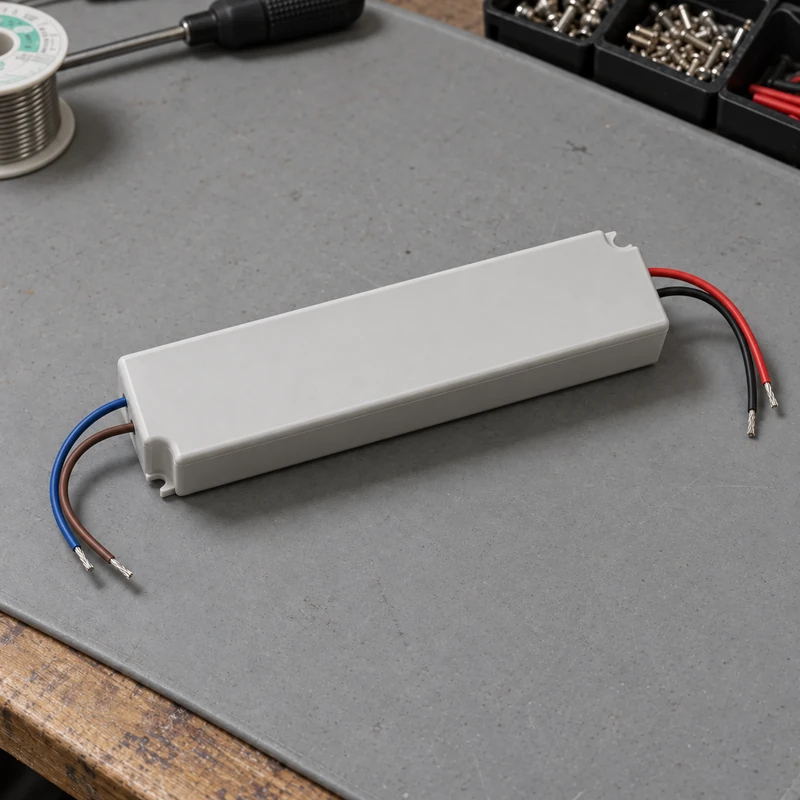
Identify how the light source is designed to operate
Ask for the exact module or strip data sheet. Does it specify a regulated current, such as a stated milliampere value, or a fixed supply voltage with its own current-limiting arrangement? A product name or photograph cannot answer that question reliably. Some assemblies include downstream electronics, which makes their requirements different from those of a bare LED package.
Record the part revision and intended operating point. Brightness, temperature and forward-voltage behavior are linked to that point. If a project uses a replacement module, do not assume the previous driver remains suitable because the module fits the same housing. Compare its electrical requirements and control behavior before approving the change.
What constant-current operation means
A constant-current driver regulates the current supplied to a compatible load while its output voltage operates within a specified range. The range matters: the load’s expected forward voltage must fit inside the driver’s regulated operating window. MEAN WELL’s LED-driver selection guidance emphasizes checking both ends of the combined forward-voltage range.
Ask the fixture engineer to confirm the module’s voltage range across the expected operating conditions. Also verify the selected output current rather than choosing the highest available setting. More current is not automatically an improvement: it changes the electrical and thermal demands on the source and can alter the approved light output.
What constant-voltage operation means
A constant-voltage supply maintains a specified output voltage for an appropriate load within its capacity. The connected light-source assembly must be designed for that supply. Many LED strips have their own current-limiting arrangement, but this should be confirmed for the exact strip. A bare LED module is not made suitable for constant-voltage operation simply by matching a nominal voltage number.
When a controller sits between a power supply and a strip, include that controller in the selection. Its voltage, current, channel arrangement and control method must match the assembly. Ask whether ratings apply per channel or to the complete controller, and document how the intended load is distributed without treating the total label as a per-channel allowance.
Compare the selection requirements
| Requirement | Constant current | Constant voltage |
|---|---|---|
| Primary match | Required regulated current | Required fixed output voltage |
| Load range | Forward voltage within the CC window | Total compatible load within supply limits |
| Dimming check | Driver input and current-control behavior | Supply/controller arrangement and output behavior |
| Main procurement risk | Wrong current or insufficient voltage window | Wrong voltage or overloaded supply/controller |
| Evidence to retain | Module and driver data sheets | Strip, supply and controller data sheets |
Some products support combined modes or configurable outputs. The MEAN WELL LED catalog distinguishes CC, CV and other output categories. Read the actual operating curves and model documentation; the phrase “LED power supply” is too broad to define compatibility.
Worked example: checking a constant-current module
Assume an engineer specifies a module operating at 700 mA with an expected forward-voltage range of 30–36 V. Assume a candidate driver regulates 700 mA over 24–42 V, and its published limits allow this operating point. The module’s electrical load spans approximately 21–25.2 W because power equals voltage multiplied by current.
A second hypothetical driver rated at a higher total wattage but limited to a 12–24 V constant-current window would not cover that module’s stated range. The larger wattage label does not repair the mismatch. These values are an arithmetic example, not specifications for products on this site. The engineer must also review startup, thermal conditions, tolerances and protection behavior.
Worked example: checking a constant-voltage strip
Assume a documented 24 V strip consumes 9 W per meter at the selected operating condition, and the planned total length is 5 m. The nominal strip load is 45 W, corresponding to approximately 1.88 A at 24 V. The designer then evaluates the power supply’s operating limits, thermal derating and the controller’s capacity against that load.
This does not establish a universal percentage margin or permissible run length. Those decisions come from the actual strip, supply and wiring design. A long run can introduce voltage-drop and distribution questions even when the supply’s total wattage appears sufficient. Have the engineer define the permitted layout and retain it with the approved component list.
Verify dimming, enclosure and service access
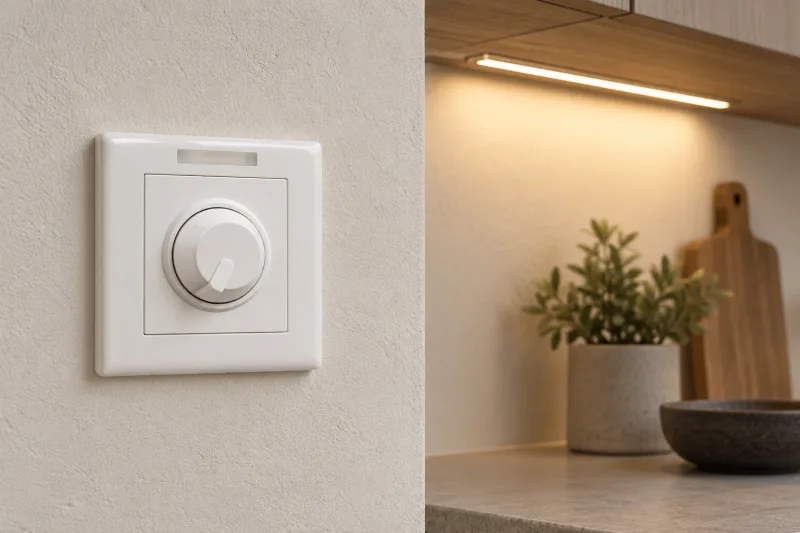
Confirm the exact dimming method, required minimum behavior and whether dimming to off is supported. Phase-cut, analog and digital control descriptions are not interchangeable. Request test evidence for the proposed driver, load and controller combination. The dimming and flicker checklist provides a practical sample sequence.
Check available enclosure space, ambient conditions, mounting orientation and heat paths. A driver rating on an open bench may not describe its permitted output inside a hot, compact housing. Ask for the relevant thermal limits and derating information. Also decide how service staff will identify and replace the exact component without changing the approved operating current or control behavior.
Send a coordinated component checklist
Include the light-source data sheet and revision, required current or voltage, load quantity, control method, enclosure drawing, environmental conditions and destination market. Request the driver’s current documentation and a reviewed compatibility statement for the complete proposed assembly. During sample approval, log the light output, control setting, temperature conditions and component identifiers.
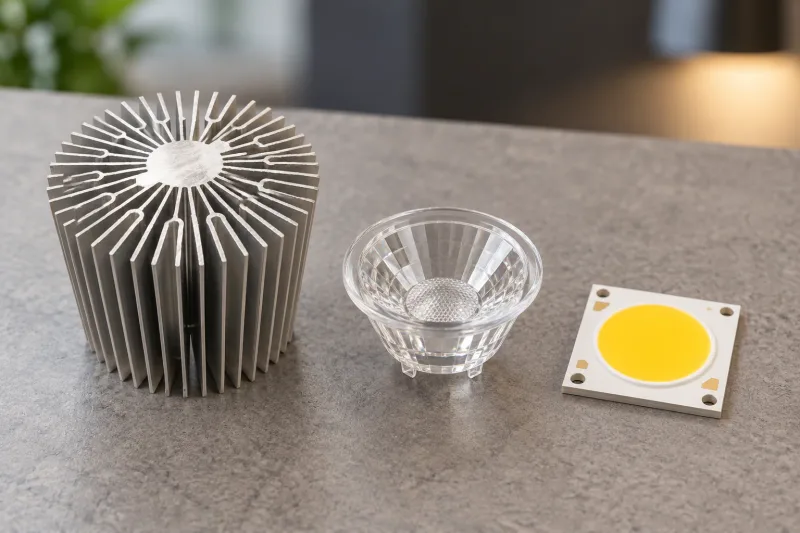
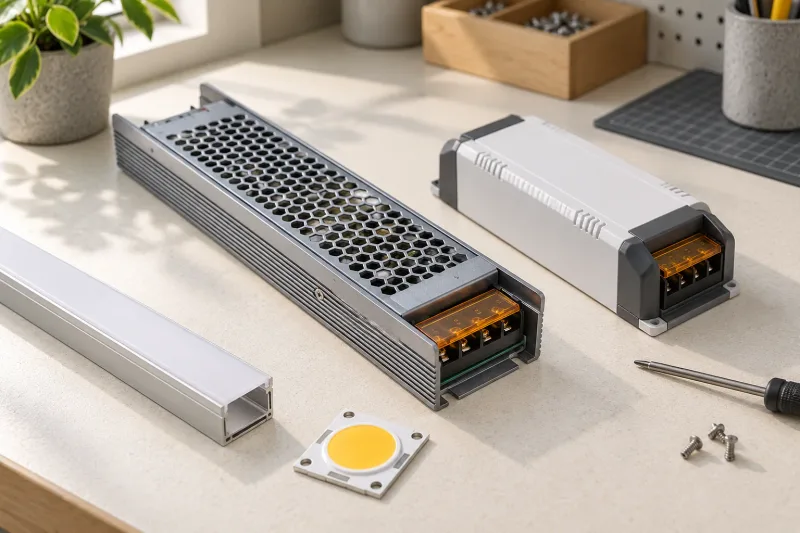
Browse drivers and power supplies, including a 320 mA constant-current driver and a 24V 45W constant-voltage supply, to compare regulation types. Custom module projects can use light source solutions. Review the heat-sink and optics guide before treating electrical compatibility as a complete fixture approval.
Frequently asked questions
Can a constant-voltage supply power any LED module?
No. The module must be designed for that supply arrangement. Obtain the exact electrical specification and have the engineer check whether additional current regulation is required.
Is a bigger driver always safer?
No. Correct regulation mode, operating window and environmental limits come first. A larger power label cannot compensate for the wrong voltage or current, and may introduce other operating considerations.
Can I replace a driver with another brand?
Only after reviewing the complete requirements. Match output behavior, control compatibility, mechanical fit, thermal limits and project documentation, then verify the replacement in the actual assembly before approval.