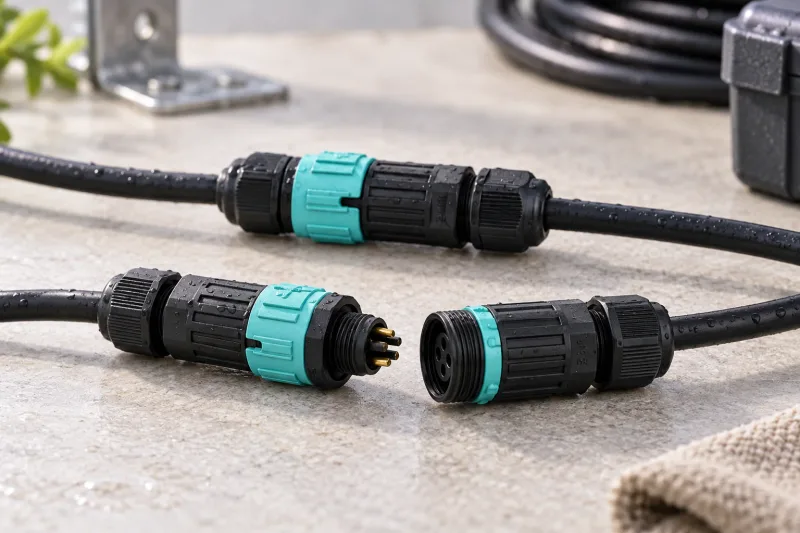
A waterproof connector is an assembly decision, not just a small accessory order. The housing, contacts, seals, cable and mating half must work together. A connector that looks correct can still fail the project because it accepts the wrong cable diameter, has a different pin assignment or provides its claimed protection only under specific assembled conditions.
The seven checks below help buyers compare proposals and prepare a meaningful sample review. They concern specification and procurement, not electrical connection instructions. The complete installation should be designed and assessed by qualified professionals for the supply, environment and destination market.
1. Define the complete mating pair
Request the exact identifiers of both halves, including their contacts, inserts and required accessories. Similar thread sizes or photographs do not prove that parts from different series are compatible. Agree which half is attached to the fixture and which belongs to the cable assembly, and keep those assignments consistent across drawings and orders.
Confirm orientation, pin count and the documented pin assignment. If a project carries both power and control, distinguish those circuits clearly in the reviewed drawing. Any exposed contacts and unmated state require an explicit design review. A buyer should not improvise a new mating arrangement because the supplier offers one half in stock.
2. Check the stated sealing conditions
Ask what the rating covers: a fully mated connector, a capped unmated half, a panel-mounted version or a particular cable termination. Request the relevant drawing and assembly documentation. TE Connectivity’s sealed connector documentation illustrates that environmental ratings can depend on specified accessories such as backshells.
An ingress rating describes a defined test condition. It does not automatically establish resistance to salt, cleaners, UV exposure or every water depth and duration. State the actual environment and ask for supporting evidence. A pond connection, a sheltered porch and a sun-exposed coastal façade need different questions even if their shopping lists all say “waterproof.”
3. Match the cable and seal geometry
Record the actual outside cable diameter, conductor sizes, jacket material and number of cores. A gland selected for the wrong outside diameter may not seal or retain the cable as intended. Do not substitute a cable solely because its conductor area appears equivalent; a different jacket can change both diameter and environmental behavior.
For factory cable assemblies, request the cable reference and permitted alternatives. For serviceable designs, ask which termination system and tools are specified, and have the responsible professional approve the process. Confirm bend space and cable exit direction in the installed location. A mechanically tight cavity can place unwanted stress on an otherwise suitable connector.
4. Check electrical limits and operating conditions
| Specification | Detail to request | Hidden mismatch to avoid |
|---|---|---|
| Voltage | Permitted voltage for the circuit and conditions | Treating every connector as mains suitable |
| Current | Contact rating with relevant derating | Using a headline value for every loaded pin |
| Cable | Diameter, cores and conductor range | Matching conductor size but missing seal fit |
| Protection | Rating and assembly conditions | Assuming the unmated half is protected |
| Mechanics | Retention, orientation and service access | A pair that fits but cannot be serviced |
A manufacturer product record, such as TE’s M12 connector specification, lists electrical, wire-size and environmental fields separately. Apply the same discipline to the proposed lighting connector. These cited products demonstrate documentation structure; their ratings do not describe KEEPSUN products or establish suitability for your project.
5. Use a worked load example carefully
Assume a reviewed low-voltage lighting circuit has three loads consuming 8 W each at 24 V DC. The nominal total is 24 W, corresponding to 1 A. The connector engineer must then check the relevant contact limits, ambient conditions, number of simultaneously loaded contacts and the actual operating behavior of the loads.
A connector advertised at 1 A is not automatically acceptable merely because the arithmetic totals 1 A. The project may require a different selection after tolerances, temperature or startup behavior are assessed. These numbers are a planning example, not a wiring design. Cable sizing, circuit protection and permissible voltage drop also belong to the reviewed system rather than to a connector’s marketing label.
6. Review retention, mating and maintenance
Specify whether the connector will be opened during service, how frequently and with what access. Request the mating-cycle information if repeated disconnection matters. A decorative housing may conceal the connector so tightly that a technician cannot release it without damaging nearby parts. Review the full service sequence using a mockup of the actual cavity.
Check whether the approved pair has a positive retention feature and how correct mating is identified. Where multiple similar circuits sit together, agree identification and coding to reduce confusion. Also establish how spare cable assemblies will be labeled and stored. A replacement with the correct physical shell but a different pin assignment creates an avoidable maintenance problem.
7. Approve the assembled sample and records
Request samples using the actual cable, seals, mating halves and accessories. Review dimensions, retention, cable stress and labeling against the controlled drawing. Ask the supplier which environmental and electrical tests support the complete assembly, and have the responsible reviewer define any project-specific verification. Appearance alone cannot establish sealing performance.
Retain the part list, drawing revision, cable reference, approved process, test evidence and spare identifiers. Specify how component substitutions are handled before production. For a custom harness, discuss in-depth customization. Coordinate the power side using driver selection and preserve the agreed assembly through the sample approval checklist.
Frequently asked questions
Does IP68 mean a connector can stay underwater indefinitely?
Do not assume that. Obtain the stated test and usage conditions for the exact assembled product, including depth and duration where applicable. Have the reviewer confirm the intended application against those conditions.
Can I mix visually similar connector halves?
Only if the manufacturer documents their compatibility and the project reviewer approves the complete pairing. Similar appearance, thread or pin count does not establish compatible contacts, coding or sealing geometry.
Can a waterproof connector make an entire fixture waterproof?
No. It is one part of the complete enclosure and cable system. The installed assembly also includes housing joints, cable entry, mounting and service details that need their own verification.