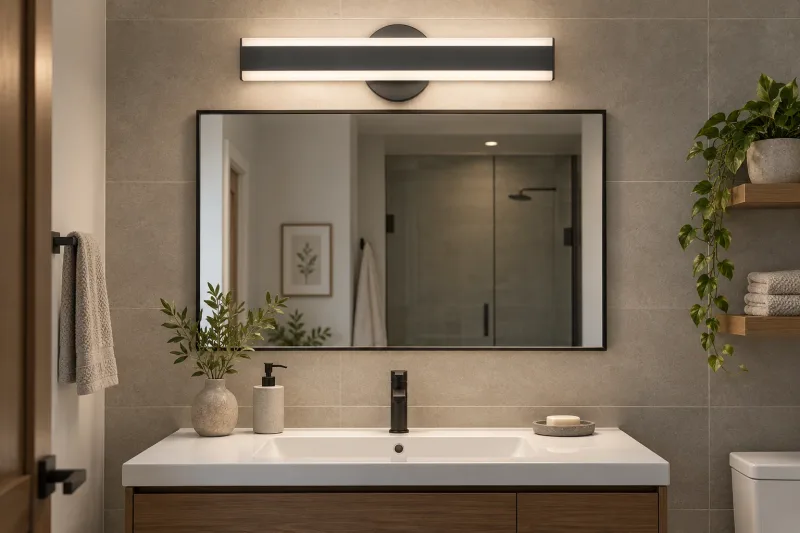
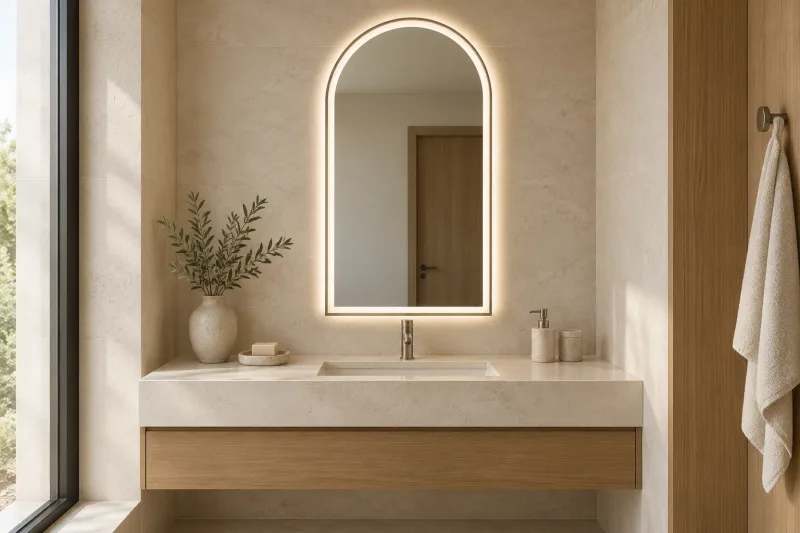
A mirror can look impressive in a product photograph and still leave a guest leaning toward the glass to shave. Buying an LED bathroom mirror means assessing two things together: the mirror as an object and the lighting it delivers at the person using it. A decorative halo, a bright perimeter and a useful grooming light can produce very different results.
For hotel purchasing teams, distributors and residential designers, the following nine checks turn a visual preference into an inquiry that suppliers can answer. Use the checks to compare quoted mirror configurations rather than assuming every pictured option is included.
1. Decide what the illuminated mirror must do
Write down the main use: everyday grooming, makeup, a soft bathroom atmosphere or a combination. ERCO’s bathroom lighting guidance recommends combining lighting functions and considering the face and reflected glare. That supports evaluating the mirror with the room lighting, instead of treating it as the complete lighting plan.
Ask the supplier where light leaves the assembly. Front-facing luminous areas, rear-facing halos and edge lighting deserve separate descriptions. A halo may be a good visual choice while additional vanity lighting provides the useful illumination. Make that division explicit in the specification.
2. Check the illuminated area at real viewing distances
Request a sample review at the distance people will stand, with the proposed mounting height and nearby finishes. Inspect the forehead, eyes, cheeks and underside of the chin. Record uncomfortable brightness, dark areas and distracting reflections. Evaluate different user heights rather than taking one photograph from a convenient camera position.
Do not infer face illumination from total mirror wattage. The shape, distribution and direction of the light matter to the task. If the project has a defined lighting target, ask the lighting designer to identify the measurement plane and test conditions. Supplier measurements become useful when they describe the same conditions.
3. Confirm size, orientation and usable reflection
The mirror’s outer dimensions are only the first part of the fit check. Include visible glass area, illuminated border width, orientation, distance from taps, and any wall-mounted accessories. A thick decorative border can reduce usable reflection even when two mirrors have the same overall size.
For repeated guest rooms, review the worst wall condition, not only the ideal room. Ask for the current dimension drawing and identify tolerances that the project team needs to coordinate. Confirm which rectangular, round or shaped options belong to the actual quotation.
4. Compare light color using actual materials
Choose a target color temperature as a project preference, then compare samples beside the specified tile, vanity finish and skin tones. A color-temperature number describes light appearance; it does not by itself establish how well colors will look. Request the stated color-rendering data and the supplier’s approach to consistency between mirrors.
For adjustable-white versions, approve both ends of the range and a preferred everyday setting. Check whether a selected setting is retained after normal switching. Keep the purchasing schedule precise: fixed-white and adjustable-white versions should have different approved references.
5. Specify controls as a complete experience
List the required actions: switch on, change brightness, change white tone or activate an optional feature. State whether these happen on the mirror, through a wall control or through a project control system. A touch icon shown in a photo does not establish dimmer compatibility.
Lutron’s compatibility tool organizes tested LED combinations by specific dimmer models. The purchasing lesson is to confirm the exact light-and-control combination. Request a written compatibility response for your proposed arrangement, then observe low brightness, restart behavior and unwanted noise in the sample.
6. Treat optional features as separate line items
An anti-fog pad, clock or integrated outlet may be useful, but each adds a decision about operation, documentation and service. Ask whether an anti-fog feature has independent switching, how its coverage is described and which part of the glass is affected. Avoid accepting a general “fog-free” promise without defined conditions.
Compare a simpler version against the feature-rich version using the same mirror dimensions and lighting configuration. This makes the price difference meaningful and prevents an accessory package from hiding a change in the light source or glass treatment.
| Configuration | Best reason to consider it | Question before approval |
|---|---|---|
| Front-lit mirror | Grooming light integrated into the mirror | Is face illumination comfortable at the intended distance? |
| Backlit mirror with separate vanity lights | Decorative halo plus independent task lighting | Do the two sources create distracting reflections? |
| Adjustable-white mirror | Different approved light appearances | Does the preferred setting return after switching? |
| Mirror with optional anti-fog feature | A defined condensation-management brief | Which area is treated and how is the feature controlled? |
7. Review bathroom suitability with the project team
Send the intended location, exposure and installation context to the qualified project professional and supplier. Ask for documentation for the exact assembly and intended market. The IEC publication covering IP codes concerns enclosure protection; a rating alone is not a complete approval for every bathroom position.
Keep protection requirements, supply details, mounting method and local requirements in the technical review. Product photography cannot settle these questions. Avoid transferring a compliance document from a similar-looking model to the version you plan to purchase.
8. Plan access before the wall is finished
Ask how the mirror is removed for service, which components can be replaced, and what access space the assembly requires. Identify whether the driver is integral or separate and ask how the supplied arrangement is documented. Serviceability affects the room downtime associated with a future repair.
For a hypothetical 40-room hotel, assume two bathroom wall widths and one control arrangement. Approve one representative sample for each width, even if the lighting specification is identical. A wider mirror can change fixing positions, packaging and the removal space available beside a wall return. This example establishes a review method, not a prescribed hotel specification.
9. Approve the purchase reference and packing
Before a bulk order, retain a dated sample record covering:
- The quoted model, dimensions, orientation and finish.
- Lighting appearance with the approved materials and normal viewing distances.
- Controls, restart behavior and separately priced features.
- Location suitability and project documentation reviewed by the responsible professional.
- Fixing drawing, service access and replaceable-part arrangements.
- Protective packaging, identification labels and a receiving inspection method.
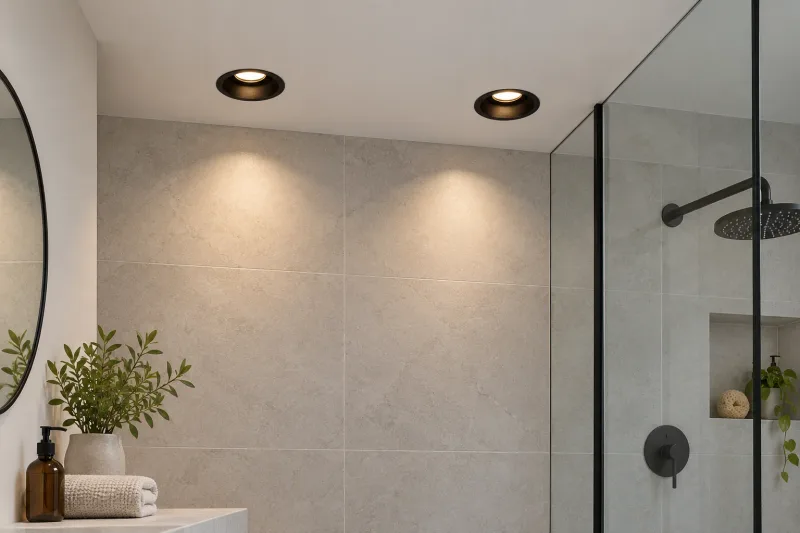
Ask the quotation to name every included item. A photograph of a bathroom accessory is not confirmation that it ships with the mirror. Discuss companion lighting through customization services, and coordinate it through our vanity light placement guide and bathroom downlight guide.
Frequently asked questions
Can an LED mirror replace vanity lights?
Sometimes, if its approved lighting reaches the face comfortably. Evaluate the real assembly and room; a decorative rear halo alone is a different function.
Which color temperature is best for a bathroom mirror?
Select it with the room palette and expected use. Approve a sample rather than treating one number as universally best for all bathrooms.
What should I send for a mirror quotation?
Send size, shape, lighting direction, controls, location, quantity and destination, along with a wall drawing and any separately required features.