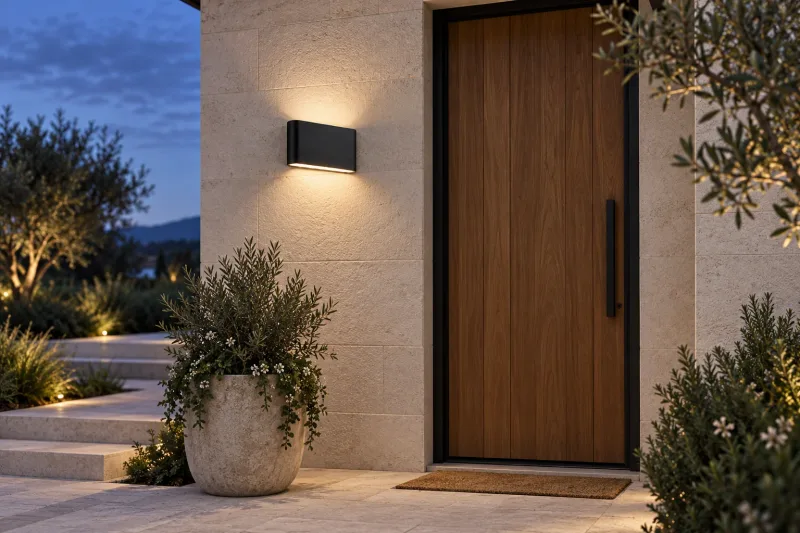
An outdoor wall light needs to do more than match the facade. It must suit the exposure, direct useful light to the intended surface and remain practical to maintain. A sheltered porch, a wind-driven-rain facade and a coastal building can require different purchasing questions even when the visual brief is similar.
This guide helps project buyers and distributors assess outdoor wall lighting. Start by describing the real location, then compare the exact quoted assembly. Styling, enclosure protection, finish durability and nighttime comfort deserve distinct checks.
Define exposure before choosing a rating
State whether the fitting sits below a roof, on an open facade or near irrigation. Describe cleaning methods, local climate and any coastal or industrial exposure relevant to the project. Include the intended mounting orientation and the wall material.
The IEC IP-code publication addresses protection provided by enclosures. For purchasing, ask the supplier how the quoted rating applies to the actual luminaire and mounting arrangement. Request the required documentation and installation conditions for professional review instead of treating the highest number on a comparison sheet as a complete solution.
Give each wall light a clear purpose
Identify whether the fixture serves an entrance, a number sign, a circulation route or a facade accent. A decorative beam on a wall does not necessarily provide useful light on the ground. Likewise, a bright ground patch can leave a door handle or sign poorly visible.
The DarkSky and IES outdoor-lighting principles call for light with a defined purpose, directed where needed and controlled for the times it is useful. Use those principles to write a precise brief: target surface, intended hours and boundaries beyond which light should be limited.
Compare beam direction and spill
An up-and-down wall light creates a different effect from a downward-only fixture or a broad diffused source. Ask the supplier for distribution information for the selected version. Confirm whether beam adjustment, shields or accessories shown in reference photography are included in the offer.
If an upward beam is proposed for a facade effect, review its purpose, termination and surrounding conditions. Inspect whether light passes the intended surface into the sky or a neighboring window. Local requirements and the site brief may constrain the proposal; obtain professional review before approving it.
| Application | Selection direction to compare | Sample question |
|---|---|---|
| Doorway and entry detail | Controlled light on useful surfaces | Can the door hardware and threshold be seen comfortably? |
| Covered walkway | Distribution following the route | Are bright patches or gaps distracting from normal viewpoints? |
| Textured facade | Beam suited to the intended wall effect | Does grazing light exaggerate unwanted surface irregularities? |
| Neighbor-sensitive boundary | Shielded light with limited spill | Is the luminous opening visible across the boundary? |
| Exposed or coastal wall | Documented enclosure and finish suitability | Does the supplier address the described exposure? |
Check glare from more than the facade view
Look from the approach path, from nearby seating and from interior windows. The source can be hidden in a straight-on photograph but visible along the path. Check the light’s reflection in glazing and wet paving as well as direct views of the aperture.
Ask whether a shielded alternative meets the same functional brief with less visible source brightness. Review it at the intended output and background light level. A sample judged in daylight or under temporary site floodlights cannot settle the nighttime result.
Evaluate finish separately from enclosure protection
Request the housing material, finish specification and care instructions for the exact product. An enclosure’s water protection does not establish its finish performance in salt-laden air. Describe the exposure so the supplier can respond with relevant evidence and any maintenance limitations.
BEGA’s metals and finishes resource discusses material and surface choices in relation to outdoor conditions. Our purchasing recommendation is to obtain an equivalent explanation for the quoted light, rather than applying another brand’s finish claims to a visually similar product. Retain an approved physical finish sample for repeat orders.
Coordinate wall fit and service access
Use the current drawing to compare backplate dimensions, projection, cable-entry requirements and the method of opening the assembly for service. Include textured render, stone joints or cladding details that can affect the mounting surface. Ask the responsible professional to coordinate the installation with the manufacturer’s requirements.
Review the available outdoor wall-light formats, then confirm the proposed configuration in writing. If a different wall-light family is suggested, request its own documentation. The same color and overall shape do not prove the same access arrangement or outdoor suitability.
Choose controls around the site’s use
Describe occupied hours, arrival routes and any desired reduced-output scene. Ask for switching, timer or sensor options compatible with the chosen assembly, without assuming that every control is available in every model. Test the response from normal approach directions where a sensor is specified.
For a hypothetical small hotel entrance, assume evening occupancy and occasional late arrivals. Compare an occupied-hours scene with a lower background scene plus an arrival response, subject to the project’s requirements. These are operating concepts, not universal output levels. Record whether the scene still allows the intended entry task and how it relates to neighboring windows.
Approve the quotation against the site brief
Before release, keep the following together:
- A marked plan with mounting positions, target surfaces and boundary conditions.
- Exact-model protection documentation and relevant mounting conditions.
- Material, finish and care information responding to the stated exposure.
- Distribution data and a nighttime sample review from approach viewpoints.
- Control behavior and the project professional’s installation review.
- Service access, replaceable-part references and included accessory list.
- Approved finish sample, drawing revision, quantities and destination.
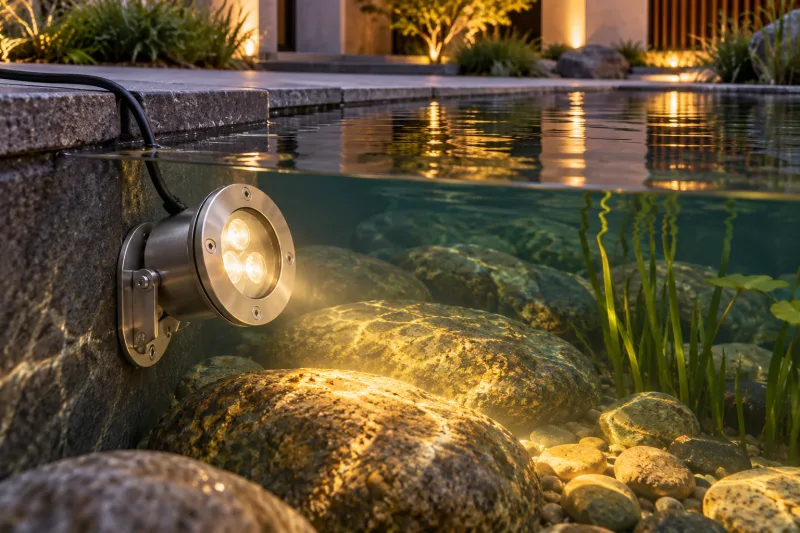
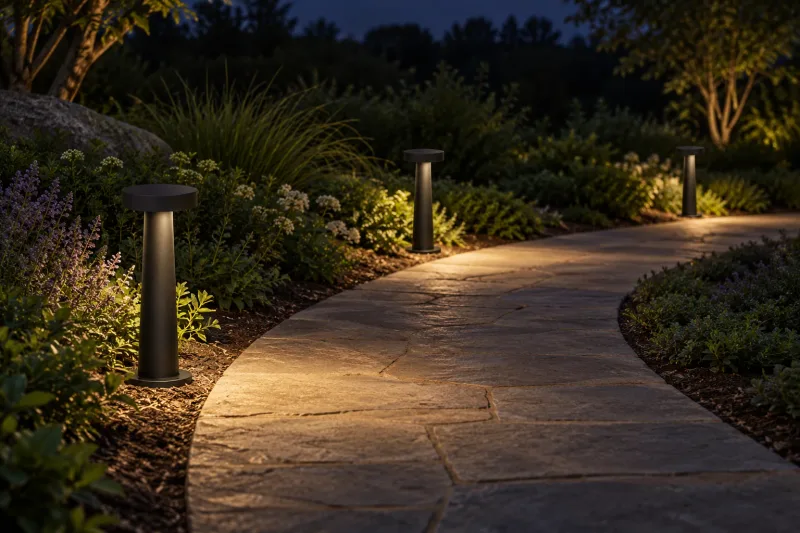
Ask the quotation to identify unresolved assumptions instead of burying them in a generic “outdoor” description. For a complete route, coordinate wall fixtures with the garden path-light spacing guide. Where the scheme includes a water feature, review the distinct conditions in the underwater pond-light guide.
Frequently asked questions
Is a high IP rating enough for a coastal wall light?
It addresses enclosure protection under its stated conditions. Material, finish, exposure, care and the complete installation still need separate review.
Are up-and-down lights suitable for every facade?
Their effect depends on the wall, beam termination and site requirements. Review spill, neighboring viewpoints and the purpose of any upward light.
What should I include in an outdoor wall-light inquiry?
Include a site photograph, mounting drawing, exposure description, target surface, control needs, quantity and destination, then ask for exact-model data.