COB and SMD are useful terms for narrowing an LED-strip search, but neither label settles an under-cabinet specification. The better choice is the assembly that provides comfortable light on the worktop, fits the cabinet detail and works with the approved driver and controls. The visible strip is only one part of that assembly.
This comparison is for designers, cabinet suppliers and lighting buyers evaluating COB flexible LED strip and SMD flexible LED strip. It focuses on decisions that can be reviewed in a sample without assuming every version of either technology performs the same way.
Start with the desired line of light
In common strip products, SMD constructions use visibly separate LED packages, while COB constructions place many emitting points beneath a continuous phosphor surface. Manufacturer VST’s COB and SMD comparison describes the resulting distinction in visible point patterns. That distinction is useful, but actual appearance still depends on the selected strip and enclosure.
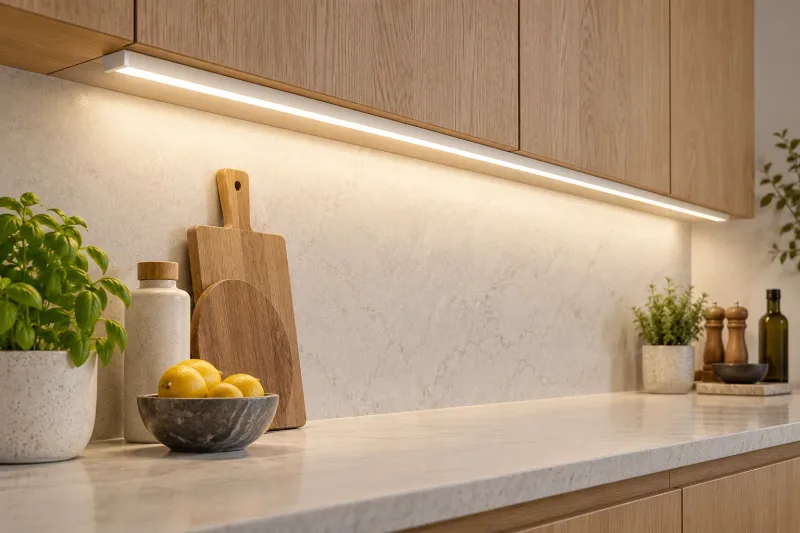
Ask whether the line itself is visible, whether the countertop reflects it, or whether it is concealed behind a cabinet edge. These conditions change how much a dot pattern matters. A strip that looks continuous when viewed directly may still show irregularities at connectors, cuts or shadows caused by the channel detail.
Compare complete channels, not bare tape
Sample the strip inside the proposed profile with its actual diffuser, end caps and mounting method. Check the available width and internal clearance, including any connector. A connector that fits the tape can still be too large for the intended profile.
Häfele’s Loox design guide treats under-cabinet light as a coordinated furniture-lighting system. Apply the same purchasing logic: specify the assembly. Keep profile, diffuser, strip, power supply and control references together so alternatives can be compared on a common basis.
Judge useful worktop light separately from dot visibility
An attractive luminous line does not establish adequate task light. Ask for output information for the quoted strip and, where available, the assembled channel. Review how the diffuser and cabinet position change light reaching the surface. Avoid comparing one bare-strip value with another value measured through a diffuser.
Inspect the worktop from its normal use position. Check for shadows near the backsplash, dark joints between runs and excessive reflected brightness. If a lighting target is part of the project brief, have the designer define the measurement plane and conditions. The sample can then be evaluated against the same brief as the calculation.
| Decision | COB direction to examine | SMD direction to examine |
|---|---|---|
| A visible line in a shallow detail | Continuous phosphor surface may be useful | Package spacing and diffuser depth need close review |
| Concealed task light | Compare actual assembled output | Compare actual assembled output |
| Reflective stone countertop | Inspect the reflected line and connectors | Inspect reflected points through the chosen diffuser |
| Complex cabinet lengths | Verify cut positions and end treatment | Verify cut positions and end treatment |
| Existing control system | Confirm driver and strip combination | Confirm driver and strip combination |
Choose light color with cabinet and worktop samples
Compare the proposed white-light appearance beside the actual cabinet finish, food-preparation surface and nearby room light. Ask for color-rendering information and the supplier’s consistency approach for the quoted model. COB construction does not itself guarantee better color rendition; SMD construction does not itself establish poorer quality.
For adjustable-white or color-changing products, name those functions separately from the strip construction. Approve the intended everyday white appearance before reviewing decorative effects. A distribution customer selling several versions should keep model references and packaging descriptions distinct so the delivered option matches the purchase order.
Review run lengths and power as a system
Send the supplier a drawing of every run, including interruptions and intended access locations. Ask for permissible run information, power requirements and the proposed driver arrangement for the exact strip. Long-run behavior depends on more than the COB or SMD name.
Waveform Lighting’s strip-support page distinguishes product options including voltage and cutting intervals. For your project, request the exact values for the selected model instead of transferring one manufacturer’s intervals to another product. The electrical designer should coordinate the supply, wiring and protective requirements from that confirmed data.
Include control behavior in the comparison
Specify how the user operates the light: wall switching, a cabinet sensor, a local dimmer or a project control system. Ask the supplier to identify the compatible driver and control method, then test the whole sample. Check low brightness, startup, setting memory if requested and unwanted audible noise.
If the quotation substitutes a driver, repeat the affected compatibility review. The tape may be identical while the user experience changes. Record the control behavior with the approved product references so a later repeat order does not become an informal substitution.
Work through a cabinet example
Assume a hypothetical kitchen with three cabinet runs totaling 3.6 m, a shallow light channel and a polished worktop. This is an example brief, not a maximum run length or wiring design. Compare one COB and one SMD assembly at equal intended worktop appearance, using the proposed diffuser and control arrangement.
The COB sample may show a smoother reflected line in the shallow profile. An SMD sample in a deeper channel may also achieve an acceptable appearance. The project decision includes joinery depth, useful output, accessory fit, price and service access. Label those tradeoffs explicitly instead of writing “COB is always better.”
Approve the assembly before buying meters
Before release, check:
- Strip construction, light appearance and model reference match the quotation.
- Profile, diffuser, connectors and end caps fit the approved cabinet detail.
- Worktop illumination and reflections have been assessed with actual materials.
- Run lengths, cutting positions and driver arrangements have supplier confirmation.
- Controls and low-level behavior pass the agreed sample review.
- Access, spare-part references and packaging identify every assembly component.
Compare alternatives in the under-cabinet lighting category, including wired cabinet and shelf lights when a complete bar assembly suits the project. Coordinate ceiling coverage using our downlight spacing guide and understand directional choices in the track-light beam guide.
Frequently asked questions
Is COB strip always dot-free?
Many COB products create a smoother visible line, but review the exact assembly, joints and reflected appearance. The construction label is not a sample approval.
Does SMD strip need a diffuser?
That depends on the intended appearance and exposure of the source. Compare it inside the proposed channel and cabinet detail rather than in isolation.
Can COB and SMD strips share a power supply?
Only when their documented electrical requirements and control arrangement support the proposed supply. Confirm the exact products with the project professional and supplier.