“OEM or ODM?” becomes a useful question only when it leads to a clear division of work. A buyer may have an approved design ready for manufacture, a concept that needs engineering or an existing platform that needs a few coordinated changes. Each starting point calls for different evidence, decisions and approval gates.
The labels alone do not define the project. Suppliers use them in different ways, and a lighting program may combine customer drawings with supplier-developed components. This guide helps you choose a working route, write an answerable brief and define the responsibilities that belong in a proposal before samples or tooling are commissioned.
Assess how ready the design really is
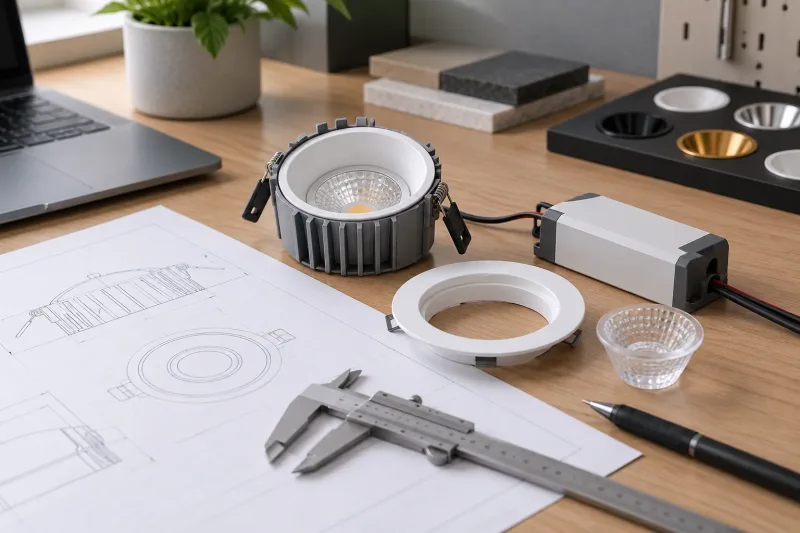
A finished rendering is not a production-ready design. Collect the current dimensional drawings, materials, LED and driver requirements, control method, finish references, assembly expectations and target market. Mark each item as approved, provisional or still to be developed. This list shows where the customer needs manufacturing execution and where additional design work remains.
Also state the application and performance objectives. A compact wall light and an outdoor floodlight impose different questions about mounting, distribution and environmental evidence. If your design relies on an existing component, identify its exact version and availability. A supplier cannot quote a meaningful production plan from a picture that hides these dependencies.
Understand an OEM-style route
In an OEM-style arrangement, the customer commonly brings a defined product or specification and asks the supplier to manufacture the agreed configuration for the customer’s brand. The practical work may still include production engineering, component sourcing and process development. Clarify which of those activities is included rather than assuming that a ready design needs no supplier review.
This route can fit a buyer with controlled drawings and an established approval process. Request a manufacturability review, a list of proposed substitutions and the records that will define production acceptance. If the supplier must redesign major parts to meet the brief, make that additional responsibility visible in the scope and milestone plan.
Understand an ODM-style route
In an ODM-style arrangement, the supplier typically contributes more of the product design and development, starting from a concept, performance brief or existing platform. The customer should still define the target user, application, brand presentation and acceptance criteria. Delegating design work does not remove the buyer’s responsibility to review whether the resulting product serves its market.
Ask what the proposed platform already establishes and what is new. A finish change differs from a new enclosure, new light engine or new control behavior. Each can need a different sample and validation sequence. Record assumptions so a proposal built around an existing module does not silently become a promise to develop an entirely new one.
Compare the routes by responsibility
| Project question | OEM-style starting point | ODM-style starting point |
|---|---|---|
| Who supplies the initial design? | Customer usually brings controlled detail | Supplier develops more detail from the brief |
| What is approved first? | Manufacturability and proposed changes | Concept, requirements and design direction |
| Where can effort be underestimated? | Production adaptation and documentation | Iteration, validation and design decisions |
| What must be written down? | Drawing control and substitution rules | Scope, design deliverables and decision gates |
| What should both routes include? | Approved sample and production criteria | Approved sample and production criteria |
Treat these as common working patterns, not formal legal definitions. Your proposal and agreement should allocate each task explicitly. A hybrid route may be suitable when the buyer owns the housing design but needs the supplier to develop a matched light source and control arrangement.
A worked project comparison
Assume a hospitality brand wants a custom wall fixture for 120 rooms. It has an approved external form, finish reference and mounting position, but no final LED module or dimming driver. Calling the whole project “OEM” leaves the light-engine development unassigned. Calling it “ODM” without detail may hide that the external design is already controlled by the customer.
A clearer scope assigns housing manufacture against the customer drawing, supplier proposals for the light engine, a driver/control compatibility review and one coordinated working sample. The team agrees who approves appearance, photometry and technical documentation at each gate. The 120-room quantity is only an invented planning scenario; it does not imply a minimum order, price or lead time offered by KEEPSUN.
Agree ownership, permissions and tooling terms
Ask which drawings, tooling, software and other deliverables will be supplied, controlled or licensed by each party. Record permitted use, change control and any territorial or exclusivity expectations. The WIPO technology-transfer overview explains that permissions and scope are established through agreement rather than inferred from collaboration labels.
This is a topic for the parties and their appropriate advisers. The practical procurement step is to identify unresolved ownership and permission questions before development begins. WIPO’s outsourcing discussion also highlights the need to consider intellectual-property responsibilities in outsourcing. Avoid treating a generic OEM or ODM title as proof of design ownership.
Use gates that match the uncertainty
Begin with a brief review, then approve a concept or manufacturability proposal as appropriate. Move to dimensional and component review, a working sample and the agreed technical evidence. Finally, release a controlled production specification. Each gate should identify the reviewer, acceptance criteria and effect of changes, so feedback does not become an untraceable series of photographs.
Ask for quotation assumptions, development charges, sample scope, tooling terms, proposed schedule and production dependencies. Lead time should be tied to specific approvals and material decisions. A sample that proves appearance may not prove electrical, thermal or environmental suitability; state exactly what remains open before the next gate.
Prepare an inquiry the supplier can answer
Include the application, destination market, product images or drawings, expected quantities by stage, required functions, finish references and known constraints. List the missing design work explicitly. Request a scope that names deliverables, reviewers and sample criteria, along with any proposed changes to your brief.
Start with OEM production, ODM development or in-depth customization, depending on the work required. A starting fixture such as the outdoor wall-light family can anchor an application discussion. Before production, use custom sample approval. If the light engine is still open, review heat sinks and optics to identify the evidence that belongs in development.
Frequently asked questions
Is ODM always faster than OEM?
No. An existing platform may reduce some work, while a new performance or appearance requirement may add development. Compare the actual scope and approval dependencies rather than the label.
Does OEM mean the buyer owns every design detail?
No. Ownership and permitted use depend on the agreement and the contributions involved. Identify customer materials, supplier materials, tooling and new deliverables explicitly, with appropriate advice where needed.
Can a project combine OEM and ODM work?
Yes. A buyer can provide a controlled housing design while commissioning development of the light engine or controls. Write the split into the scope and approve the complete assembled sample before production.