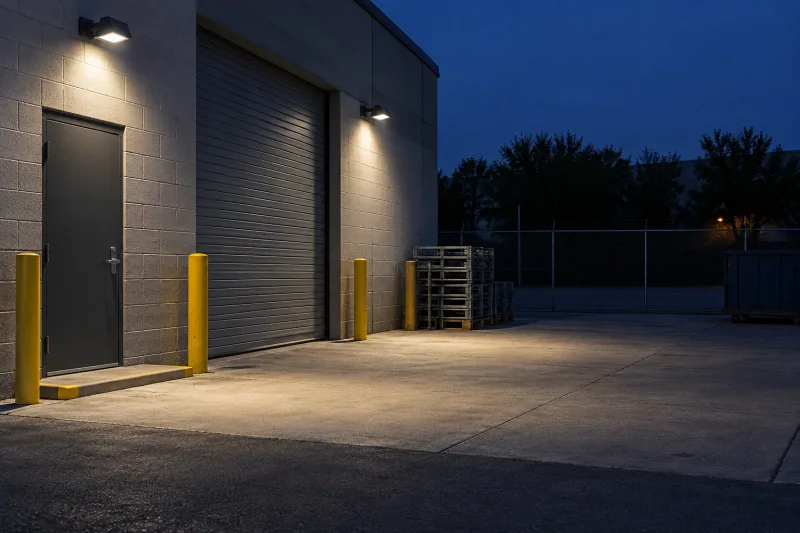
The right security floodlight makes an entrance or working area easier to see without turning nearby windows into bright rectangles. There is no single lumen figure that fits every yard. A fixture’s output matters, but so do mounting height, beam distribution, surface reflectance, obstacles and the way people approach the building.
A useful purchase decision begins with an area and a task: recognizing a visitor at a doorway, moving goods across a loading zone or observing a vehicle gate. Once that task is clear, a designer can connect the required visibility to a layout, and a buyer can compare floodlights against the same assumptions.
Define the area and the viewing task
Draw the area to be illuminated and mark doors, pedestrian routes, vehicles, cameras and neighboring boundaries. Separate a small entrance from a large maneuvering space. If a proposal tries to serve both from one powerful fixture, examine whether people will face the beam while approaching the door.
Record mounting height, permitted fixing points and the viewing direction of any camera. Add trees, signs, awnings and parked vehicles that may block coverage. Surface color also matters to the visual result: a dark asphalt yard looks different from a pale wall or painted pavement. These conditions should appear in the brief, not be discovered after delivery.
Why lumens do not answer the whole question
Lumens describe the quantity of visible light emitted by the source or fixture, depending on the published measurement. Illuminance, measured in lux, describes light arriving on an area. ERCO’s illuminance guide explains the distinction between light arriving on a surface and emitted flux. Ask which lumen value is being quoted, and request a photometric file or distribution diagram that supports a layout at your mounting position.
A wide beam may cover a larger area while delivering less light to a particular point. A narrow beam can create a bright patch and leave the approach route dark. The goal is an appropriate distribution for the task. The DarkSky and IES principles favor purposeful, targeted and controlled outdoor lighting rather than unnecessary brightness.
Compare beam distribution and glare
Request a layout that shows the area of interest and the site boundary. Check edges, corners and the route between the bright zone and the building. A strong average can hide a dark strip where a person changes direction or crosses an uneven surface. Include any vertical task, such as seeing faces or labels, in the designer’s review.
Inspect the proposed aiming and shielding from normal eye positions. Visitors should not have to look directly into an exposed high-output source. A camera view also needs testing because a bright fixture or reflective surface can affect the recorded scene. Do not infer camera performance from how the area appears to a person standing elsewhere.
Select a sensor for actual movement
| Situation | Control question | Sample check |
|---|---|---|
| Visitor entrance | Does it detect the expected approach? | Walk the normal route from both directions |
| Service yard | Should occupancy activate one zone or several? | Check moving people and parked obstructions |
| Roadside boundary | Can passing traffic trigger it? | Observe events outside the intended area |
| Camera observation zone | Is a steady background level required? | Review footage through the transition |
| Overnight closure | What happens during scheduled inactive hours? | Verify time and override behavior |
Specify detection coverage separately from lighting coverage. They are different maps. Also agree the delay, dusk threshold, manual override and behavior after a power interruption. If the site has shift changes, cleaning or deliveries outside regular hours, include those use cases before choosing a control arrangement.
A worked example with clear limits
Assume a 6 m by 4 m entrance zone, giving 24 m². Assume the project designer selects 30 lux as an initial average planning level, a utilization factor of 0.45 and a maintenance factor of 0.8. A preliminary lumen estimate is 30 × 24 ÷ (0.45 × 0.8), or approximately 2,000 fixture lumens.
These factors and the target are hypothetical project assumptions, not universal security requirements. A proposed 2,000-lumen fixture still needs a distribution review. It may fail at the far corner, spill toward a neighbor or create glare near the door. Conversely, a well-placed alternative with a different beam may serve the task more effectively. Use the arithmetic to start a design conversation, then verify the layout and sample.
Review environmental and maintenance requirements
Outdoor protection is only one part of the specification. Ask for the housing and cable-entry details, operating temperature limits, finish suitability for the environment and any documented cleaning restrictions. A published ingress rating should be evaluated for the complete intended assembly. It does not, on its own, establish coastal corrosion resistance or suitability for every exposed location.
Consider access for adjusting, cleaning and servicing the fitting. If a fixture sits above parked vehicles, explain how maintenance will occur. Agree whether sensors and drivers are replaceable and which spare records will be retained. Keep the exact model and control variant on the maintenance schedule so a later replacement preserves the approved coverage and behavior.
Build a floodlight inquiry and sample plan
Send the site sketch, task description, mounting options, boundary constraints, camera positions and expected control events. Request drawings, fixture photometry, the proposed aiming plan and relevant environmental documentation. During the sample review, check arrival, departure, stationary work, passing traffic and restart behavior; record output and sensor settings with photographs from repeatable positions.
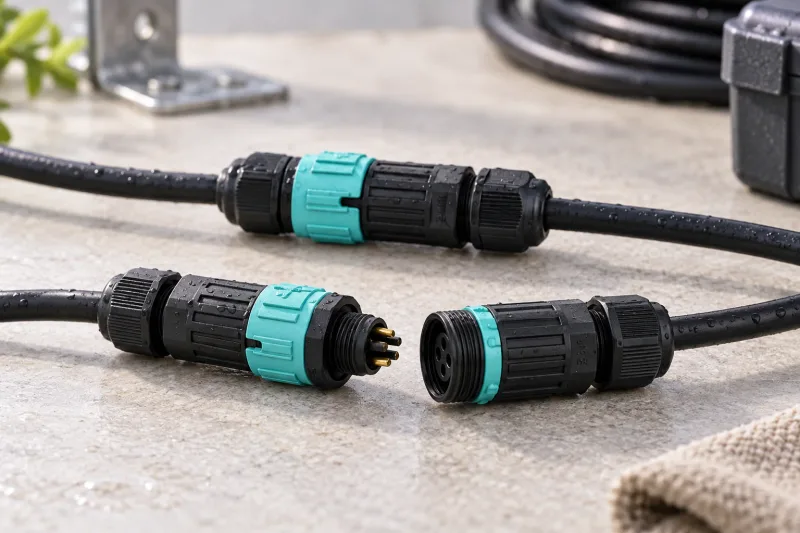
Explore the floodlights and spotlights category to identify a starting fixture, then confirm sensor and control requirements separately. A custom bracket or control response can be discussed through in-depth customization. Before approving an order, use the sample approval checklist. For outdoor connections, see the waterproof connector selection guide.
Frequently asked questions
Should I buy the highest lumen option?
Choose the output supported by the task and layout. Excess output may increase glare and spill while doing little for dark areas outside the beam. Request an appropriate distribution and controllable settings where the application needs them.
Can a motion sensor replace a lighting design?
No. A sensor determines when a light responds; it does not establish coverage or visibility. Test both the detection zone and the illuminated scene, including obstacles and the transition between background light and the activated setting.
Will a security floodlight guarantee better security?
No fixture can guarantee that outcome. Lighting is one part of a wider site strategy. Define what people or cameras need to see, check the result on site and coordinate it with the operator’s other security measures.