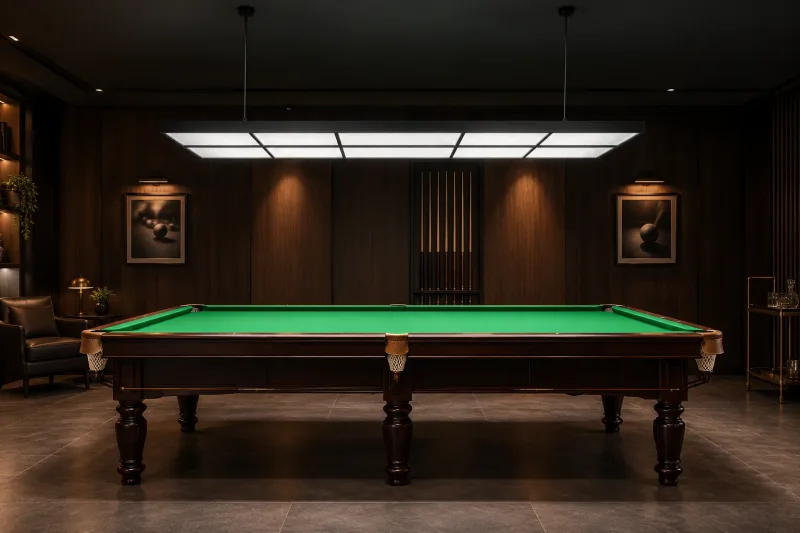
A billiard light should help players read the table, follow the balls and judge a shot from different positions. A fixture can look perfectly centered in a room photograph while leaving the cushions dark or placing a bright source directly in a player’s view. Fixture length and hanging height should therefore be chosen together with beam distribution and the measured playing surface.
This guide helps buyers prepare a useful brief for a home game room, hospitality venue or club. Tournament requirements must be confirmed with the relevant event organizer. A visual mockup can establish appearance, but it cannot replace an illuminance check across the table.
Measure the playing surface and room
Record the playing surface from cushion nose to cushion nose, rather than using only the table’s nominal size. Include the outer table dimensions, bed height, ceiling height and ceiling fixing constraints. Photograph the room from both long sides and both ends so the supplier can understand the viewing positions and surrounding light.
Mark the table’s intended final location. Centering a pendant on the ceiling rose is unhelpful if the table moves during fit-out. Also record beams, fans, sprinklers, signs and other ceiling features that constrain suspension. A drawing should identify the table centerline and fixture centerline separately, with dimensions that allow the contractor to coordinate the finished arrangement.
Choose coverage before decorative proportions
A long playing surface generally calls for a distribution that reaches both ends without an excessive bright center. A linear diffuser, several shaded heads and a broad panel can each achieve different results. None can be evaluated from length alone. Ask for the distribution and proposed mounting distance above the bed.
Consider the rails and pockets as part of the review area, not just the central cloth. Balls approaching a cushion should remain visible. Shade shape, diffuser texture and internal source position influence glare and coverage. If a decorative fixture uses several separate lamps, review the overlap between heads and confirm the specified lamps rather than substituting any physically fitting bulb.
Treat hanging height as a design variable
A lower fixture may concentrate light on the table, but it can interfere with views and access. A higher position can broaden coverage while reducing illuminance on the surface. Ask the designer to assess both lighting and practical clearances. Adjustable suspension can help during a mockup, provided the chosen product supports the required range.
The official WPA recommended equipment specifications contain lighting provisions for WPA events, including 520 lux at points on the bed and rails. They explicitly do not necessarily apply to commercial home tables. Confirm the applicable event rules rather than presenting a tournament value or hanging distance as a universal home-installation rule.
Compare fixture arrangements
| Arrangement | Potential advantage | Check before approval |
|---|---|---|
| Multiple shaded heads | Traditional appearance and directed zones | Dark gaps, lamp consistency and glare |
| Linear diffused pendant | Continuous visual line above the table | Edge coverage and diffuser luminance |
| Broad suspended panel | Wide distribution from a larger area | Room clearance and visible source brightness |
| General room lighting only | Clear ceiling above the table | Whether shadows and rail coverage remain acceptable |
The table is the main task surface, but the room still needs an intentional background. Very bright table lighting in an otherwise dark room can make movement away from the table uncomfortable. Ask how nearby seating, scoreboards and circulation areas will be lit, and verify that their reflections do not distract players.
A worked coverage review
Assume a private game-room table has a measured playing surface of 2.24 m by 1.12 m. Assume the buyer is comparing a 1.4 m linear pendant with a three-head decorative fitting. For the mockup, a designer proposes two permissible suspension settings and a nine-point measurement grid on the playing surface, plus additional rail readings.
At one setting, the hypothetical linear fitting produces 460 lux at the center and 280 lux near an end; at another, the readings are 390 and 330 lux. The second arrangement is more even, but whether its level is acceptable still depends on the project target. These invented readings demonstrate a comparison method, not a product specification. Retain the complete grid and view checks rather than selecting a fitting from the highest center number.
Specify color, dimming and visible finish
Ask for a consistent light color and suitable color-rendering evidence for the chosen source. Cloth and ball colors should remain recognizable, and the appearance should suit the room. If several tables share a space, avoid unplanned variation between fittings. A lighting sample beside the actual cloth is more useful than comparing small swatches on a screen.
If dimming is required for general hospitality use, define the normal play scene and any lower ambient scene separately. Check stability, restart behavior and whether staff can return to the agreed play setting. The LED dimming compatibility guide explains why the exact control and light source should be tested together.
Create a sample and installation brief
Send the surface dimensions, room photographs, ceiling information, desired style and lighting target. Request the fixture drawing, suspension range, nominated lamp or module, control requirements and photometric evidence. In the mockup, inspect the cloth, rails, pockets and player eye positions. Check shadows with a person leaning into a shot from both sides and verify visibility across the table.
Record the final distance from the bed to the fixture and the approved source configuration. Qualified installers should confirm structural fixing and electrical suitability. For a custom length or suspension, discuss in-depth customization and use the custom sample approval checklist before releasing production.
Frequently asked questions
What is the best hanging height for a billiard light?
It depends on fixture distribution, clearances and the table’s requirements. Use the manufacturer’s permitted suspension range and an application review. Tournament specifications have a defined scope and should be checked for the particular event.
Should the fixture be as long as the table?
Not automatically. Fixture length affects appearance but does not establish coverage. Review the proposed distribution at the intended height and measure the ends and rails during the mockup.
Can I approve the light from a photograph?
ERCO’s measurement guidance recommends appropriate calibrated instruments for illuminance assessment. A photograph is useful for finish and proportions, but exposure settings can hide bright spots and dark areas. Combine repeatable photographs with measurement-grid readings and player-position checks before accepting the lighting arrangement.